
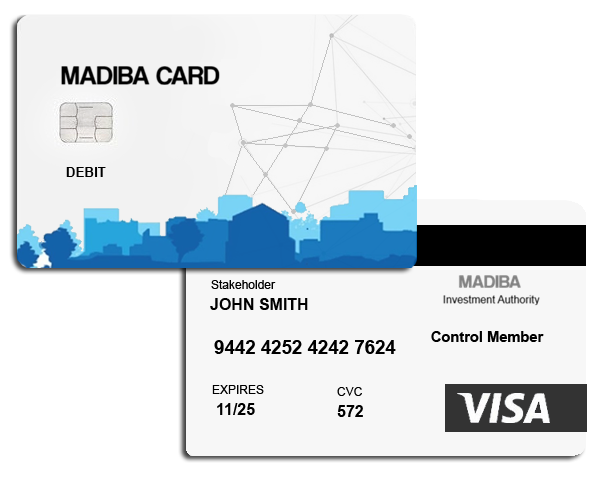
Register with MADIBA Sponsored Community Investment Programs and Receive Your MADIBA Card

PURPOSE
The MADIBA Card Program (“Program”) provides eligible MADIBA members with controlled access to commercial payment-card services through a sponsoring financial institution and applicable card-network infrastructure.
The Program is designed to connect:
HSC Corporate Ledger → Bank Sponsorship → Card Processor → Card Network → Merchant
The Program allows an approved member’s authorized spending account to be funded, controlled, monitored, and reconciled through the HSC treasury-management framework while settlement occurs through regulated banking and payment infrastructure.
The MADIBA Card Program is therefore a treasury and commercial payment service, not a banking charter, deposit-taking institution, or independent card network.
Controlled Virtual Card For online purchases, subscriptions, vendor payments, and transaction-specific spending.
PROGRAM OBJECTIVES
The Program shall:
- Provide eligible MADIBA members with commercial payment-card access.
- Connect approved member obligations to controlled spending accounts.
- Provide transaction-level authorization and spending controls.
- Maintain a corporate non-cash ledger of authorized obligations and transactions.
- Maintain a reconciliation relationship between the MADIBA ledger and the sponsoring bank.
- Support corporate purchasing, project expenses, supplier payments, travel, administration, and other approved commercial activities.
- Provide auditable transaction records.
- Support MADIBA underwriting and member-risk controls.
- Prevent unauthorized use of MADIBA treasury resources.
- Provide a structured bridge between MADIBA’s private corporate ledger and regulated bank settlement rails.
ELIGIBLE CARDHOLDERS
The initial MADIBA Card Programs shall be restricted to approved commercial participants.
Eligible users may include MADIBA members:
- corporations, LLCs, partnerships, trusts where commercially appropriate;
- project entities;
- approved contractors;
- approved suppliers;
- authorized officers;
- authorized employees;
- approved agents;
- and other approved business-purpose users.
Consumer-purpose enrollment shall not be permitted under the commercial program.
Each cardholder must be associated with an approved member organization and an authorized MADIBA account.
CARD TYPES
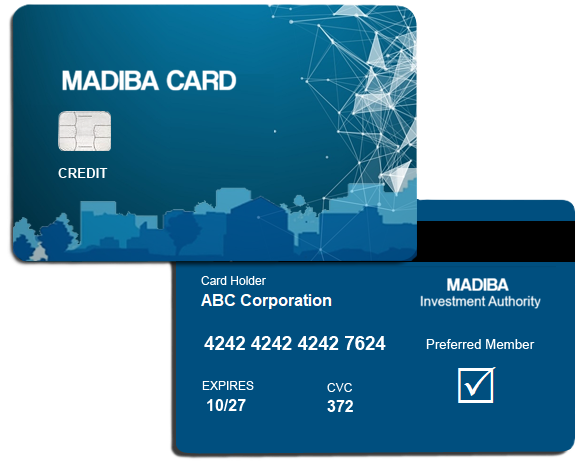
TBO may establish two basic multiple card classes.
Credit Card
Designed for cash credit member
Debit Card
Designed for cash flow members
Cash Flow Members are investor who purchase TBO bonds through cash purchase program development credit underwritten and distributed through TBO.
Cash Credit Member is who investors who grant cash for equity ownership
Multiple Card Classes.
Project Card Restricted to
- a specific project, development activity, or work order.
- For approved purchases from suppliers and vendors.
- For expenses associated with an approved investment or development program.
- For approved contractor expenses subject to a work order or contract.
Administrative Card For TBO/HSC administrative expenses.
CARD CONTROLS
HSC may establish controls based on:
- transaction amount;
- daily spending;
- monthly spending;
- merchant category;
- merchant;
- geographic location;
- online/in-person use;
- ATM availability;
- cash withdrawal;
- project;
- work order;
- supplier;
- cardholder;
- time period;
- number of transactions;
- and available account balance.
Controls shall be established before card activation when practicable.
WORK ORDER CONTROL
Where a card is associated with a project, HSC may require a valid Work Order.
The Work Order may identify:
- project;
- member;
- contractor;
- supplier;
- authorized amount;
- authorized period;
- approved goods/services;
- responsible administrator;
- funding source;
- cardholder;
- and supporting documentation.
A card transaction may be automatically compared against the applicable Work Order before authorization.
REAL-TIME AUTHORIZATION
The authorization layer may evaluate:
- card status;
- available balance;
- approved limit;
- merchant category;
- transaction amount;
- member status;
- project status;
- Work Order status;
- fraud indicators;
- compliance restrictions;
- and other approved controls.
AVAILABLE BALANCE
The Program shall distinguish between:
Ledger Balance The amount recorded within the HSC accounting system.
Available Card Balance The amount currently available for card authorization.
Pending Amount Authorized transactions that have not yet settled.
Settled Amount Transactions confirmed through the bank/processor settlement process.
Reserved Amount Funds temporarily reserved for an approved transaction or obligation.
The HSC system shall not represent a pending or internal ledger amount as settled cash.
CARD ACTIVATION
Before activation, HSC shall confirm:
- MADIBA approval;
- cardholder identity;
- authorized representative;
- account status;
- funding status;
- spending limit;
- applicable compliance review;
- card controls;
- and required agreements.
The cardholder shall acknowledge the MADIBA Cardholder Agreement before use.
CARDHOLDER RESPONSIBILITIES
Each cardholder shall:
- Use the card solely for authorized business purposes.
- Protect card credentials.
- Immediately report lost or stolen cards.
- Maintain transaction documentation.
- Avoid personal purchases.
- Avoid unauthorized cash transactions.
- Follow applicable spending limits.
- Follow applicable Work Orders.
- Submit receipts and supporting records when required.
- Cooperate with audits and transaction reviews.
PROHIBITED TRANSACTIONS
Unless specifically approved under a separate program, prohibited transactions include:
- personal expenses;
- unauthorized cash advances;
- unauthorized person-to-person transfers;
- gambling;
- unlawful goods or services;
- transactions intended to evade AML controls;
- transactions designed to conceal the beneficial owner;
- transactions outside the approved commercial purpose;
- unauthorized related-party transactions;
- transactions exceeding approved limits;
- and transactions that violate applicable law or the sponsoring bank’s program requirements.
The bank, processor, network, or HSC may impose additional prohibited-merchant restrictions.
COMMERCIAL-PURPOSE STATUS
The MADIBA Card Program is designed for commercial-purpose transactions.
MADIBA shall obtain appropriate representations regarding business purpose and shall maintain documentation supporting the commercial nature of the account.
However, classification shall depend on the actual facts and structure of the account and card relationship. The Program shall not rely solely upon contractual language to determine whether a transaction or account is outside consumer-protection laws.
Where a product is offered to consumers or otherwise falls within consumer financial regulations, the applicable requirements shall be incorporated into that product’s separate compliance framework.
PREPAID ACCESS CLASSIFICATION
The parties shall evaluate:
- whether funds are paid in advance;
- whether the card provides access to prepaid value;
- whether the card is open-loop or closed-loop;
- whether the card can be used at unaffiliated merchants;
- whether the card can be reloaded;
- who controls the program;
- who provides the prepaid access;
- whether funds can be transferred between users;
- whether international transactions are permitted;
- and applicable value thresholds.
FinCEN defines prepaid access broadly and provides specific exclusions and requirements depending upon the structure of the program.
TBO shall therefore obtain written program classification from the sponsoring bank, processor, and applicable compliance counsel before production launch.
BANKING RELATIONSHIP
The sponsoring bank shall maintain the regulated bank account(s) used for the Program. HSC does not represent the bank account as a HSC deposit account unless HSC itself becomes legally entitled to make such a representation.
CARD ISSUANCE
Cards may be:
- physical;
- virtual;
- tokenized;
- single-use;
- reusable;
- or otherwise configured by the approved processor.
Issuance shall occur only after the applicable member and cardholder approvals have been completed.
VIRTUAL CARD PROGRAM
MADIBA may issue virtual cards for:
- supplier payments;
- online purchases;
- subscriptions;
- project expenses;
- contractor payments;
- controlled procurement;
- and transaction-specific obligations.
Virtual cards may be configured with:
- single-use numbers;
- merchant restrictions;
- dollar limits;
- expiration dates;
- project restrictions;
- and transaction-specific controls.
FRAUD MANAGEMENT
The Program shall maintain layered fraud controls.
These may include:
- velocity monitoring;
- transaction anomaly detection;
- merchant-category restrictions;
- card freezing;
- geographic controls;
- device monitoring;
- unusual spending alerts;
- duplicate transaction detection;
- compromised-card detection;
- and manual review.
Suspicious activity shall be escalated according to the applicable HSC and bank procedures.
DISPUTES AND ERRORS
The Program shall maintain a documented process for:
- unauthorized transactions;
- duplicate transactions;
- incorrect amounts;
- merchant disputes;
- processing errors;
- refunds;
- reversals;
- chargebacks;
- and cardholder complaints.
Where the sponsoring bank or processor controls the applicable dispute process, HSC shall coordinate with that party and maintain corresponding records.
RECONCILIATION
HSC shall reconcile:
It’s Treasury Bank against Bank Account against Processor Ledger against Card Transaction File at an established frequency.
Reconciliation shall identify:
- outstanding authorizations;
- settled transactions;
- reversals;
- refunds;
- fees;
- discrepancies;
- funding movements;
- and unresolved exceptions.
Material discrepancies shall be escalated to HSC Administration and Banking.
ACCOUNTING TREATMENT
HSC shall maintain separate accounting classifications for:
- cash;
- restricted cash;
- member allocations;
- internal credit;
- card balances;
- receivables;
- payables;
- card obligations;
- settlement amounts;
- fees;
- and disputed transactions.
No internal ledger entry shall be classified as bank cash solely because it represents an approved ledger obligation.
Accounting treatment shall follow the applicable legal ownership of the funds and the organization’s accounting policies.
FEES
The Program may charge card holder through following subscriptions:
| Subscriptions | Monthly Fee |
| Basic | $35 |
| Business | $100 |
| Enterprise | $500 |
| Institutional | Negotiated |
Fees will be disclosed to members and structured consistently with applicable law and the sponsoring bank/processor agreement.
INTERCHANGE
Where the Program generates interchange revenue, the revenue allocation shall be established by contract among the applicable parties.
MADIBA shall not assume that all interchange revenue belongs to HSC.
Treatment may depend on:
- card type;
- issuing institution;
- network;
- transaction type;
- applicable exemptions;
- program agreements;
- and applicable law.
Federal Reserve Regulation II establishes interchange standards for covered debit transactions and contains specific treatment for certain prepaid cards, so the final economics should be confirmed with the issuing bank and processor before launch.
DATA AND RECORDKEEPING
HSC shall maintain appropriate MADIBA records concerning:
- member applications;
- underwriting;
- card issuance;
- cardholder authorization;
- transactions;
- funding;
- settlement;
- reconciliation;
- disputes;
- compliance reviews;
- account changes;
- card termination;
- and audit activity.
Records shall be retained according to HSC’s record-retention policy and applicable law.
AUDIT
The HSC and MADIBA Audit function shall periodically review:
- Member eligibility.
- Cardholder authorization.
- Funding.
- Transaction activity.
- Spending limits.
- Work Orders.
- Reconciliation.
- Exceptions.
- Fraud controls.
- AML/BSA controls.
- Bank settlement.
- Program fees.
- Card cancellations.
- Dormant accounts.
- Outstanding obligations.
Material findings shall be reported to MADIBA and HSC corporate governance.
CARD SUSPENSION
HSC or MADIBA may request suspension of a card when:
- the member becomes inactive;
- the cardholder loses authorization;
- the account becomes underfunded;
- suspicious activity is detected;
- the Work Order expires;
- the project terminates;
- the card is reported lost or stolen;
- compliance documentation expires;
- or a program violation occurs.
The sponsoring bank or processor may independently suspend or terminate a card pursuant to its own rules.
CARD TERMINATION
A card shall be terminated when:
- membership terminates;
- the authorized relationship ends;
- the underlying project ends;
- the account is closed;
- the cardholder is removed;
- the card is compromised;
- or the sponsoring bank/processor terminates the card.
All outstanding transactions shall be reconciled before final account closure where practicable.
GOVERNANCE
The Program shall be governed through the HSC/ MADIBA framework:
Membership – Eligibility and member relationship.
Administration – Cardholder management and operational controls.
Development – Project and commercial-purpose authorization.
Investment – Funding and capital allocation.
Banking – Bank, processor, network, settlement, and treasury integration.
Audit– Records, reconciliation, compliance, and independent review.
HSC, as corporate trustee, provides overarching governance and fiduciary oversight.
PROGRAM LIMITS
HSC shall establish limits based upon:
- member financial capacity;
- approved funding;
- underwriting;
- project requirements;
- transaction risk;
- cardholder role;
- bank requirements;
- processor requirements;
- fraud exposure;
- and applicable compliance requirements.
No member shall receive unlimited card access merely because it has an internal HSC ledger balance.
NO UNAUTHORIZED CREDIT CREATION
The MADIBA Card Program shall not be used to represent internal ledger entries as guaranteed bank credit.
Where HSC provides a private credit or treasury allocation, the Program documentation must clearly identify:
- source of funds or credit;
- legal obligor;
- repayment obligation;
- collateral, if any;
- available amount;
- conditions precedent;
- bank funding status;
- and settlement status.
A HSC approval is not itself a bank commitment.
MEMBER AGREEMENT
Each participating member shall execute a Card Program Agreement addressing:
- eligibility;
- cardholder authorization;
- commercial purpose;
- spending limits;
- fees;
- funding;
- transaction responsibilities;
- prohibited transactions;
- dispute procedures;
- compliance;
- data use;
- termination;
- indemnification;
- and applicable governing law.
BANK SPONSORSHIP REQUIREMENT
Before production launch, HSC shall obtain a sponsoring bank/program agreement defining the respective responsibilities of:
HSC → MADIBA → Bank → Processor → Network
The agreement should specifically identify:
- issuer;
- program manager;
- prepaid-access provider, if applicable;
- processor;
- sponsor bank;
- settlement bank;
- account ownership;
- funds flow;
- compliance responsibilities;
- KYC/CIP responsibilities;
- AML responsibilities;
- OFAC responsibilities;
- transaction monitoring;
- chargebacks;
- disputes;
- fraud;
- data ownership;
- card issuance;
- and termination rights.
KEY PROGRAM DOCUMENTS
MADIBA Card Program shall be supported by:
- Card Program Policy.
- Cardholder Agreement.
- Member Card Program Agreement.
- Bank Sponsorship Agreement.
- Processor Agreement.
- Card Network Agreement, where applicable.
- AML/BSA Policy.
- OFAC/Sanctions Policy.
- Fraud Management Policy.
- Privacy and Data Security Policy.
- Transaction Dispute Policy.
- Treasury Funding Policy.
- Bank Integration and Settlement Policy.
- Member Underwriting Policy.
- Work Order Policy.
- Card Issuance and Activation Procedure.
- Card Cancellation Procedure.
- Reconciliation Procedure.
- Audit Procedure.
- Card Fee Schedule.
PROGRAM DISCLOSURE
All marketing and member documentation shall clearly state:
MADIBA is not a bank and that it provides commercial treasury administration, member underwriting, ledger, authorization, and program-management services. Banking, deposit, card-issuing, settlement, and other regulated financial services are provided by appropriately authorized third-party financial institutions and service providers pursuant to applicable agreements.
Additional disclosures shall be added as required by the sponsoring bank, card network, processor, and applicable law.
CARDHOLDER AGREEMENT
MADIBA Authority
Corporate Trustee: Hill Scott Corporation (HSC)
1. Purpose
This Cardholder Agreement (“Agreement”) governs the use of a MADIBA Card (“Card”) issued through a sponsoring financial institution and administered through the HSC treasury ledger and as MADIBA framework.
The Card is intended solely for approved commercial, business, project, administrative, investment, procurement, contractor, or treasury purposes.
2. Parties
This Agreement is entered into between:
- Hill Scott Corporation (HSC);
- MADIBA Authority as participating Member Organization (“Member”);
- The Authorized Cardholder (“Cardholder”);
- The Sponsoring Financial Institution and Card Processor, where applicable.
3. Commercial Purpose
The Cardholder certifies that:
- The Card will be used solely for business or commercial purposes.
- Personal transactions are prohibited unless expressly approved.
- The Cardholder acts on behalf of an approved Member.
4. Cardholder Responsibilities
The Cardholder agrees to:
- Protect the card and credentials.
- Maintain passwords and security codes.
- Submit receipts and documentation.
- Follow approved spending limits.
- Use funds only for authorized purposes.
- Follow Work Orders and project restrictions.
- Immediately report loss, theft, or unauthorized use.
- Cooperate with audits and reviews.
5. Spending Controls
The Card may be subject to:
- Daily limits;
- Monthly limits;
- Merchant category restrictions;
- Geographic restrictions;
- Project restrictions;
- Work Order limits;
- Supplier controls;
- Virtual card controls.
MADIBA may modify controls at any time.
6. Prohibited Transactions
The Card shall not be used for:
- Personal expenses;
- Gambling;
- Illegal activities;
- Unauthorized cash withdrawals;
- Transactions intended to evade compliance controls;
- Unauthorized related-party transactions;
- Expenditures exceeding approved limits.
7. Receipts and Documentation
Cardholders shall provide:
- Invoices;
- Receipts;
- Work Orders;
- Purchase Orders;
- Supporting documentation.
Failure to provide documentation may result in suspension.
8. Lost or Stolen Cards
The Cardholder must immediately notify MADIBA upon:
- Lost card;
- Stolen card;
- Compromised credentials;
- Suspected fraud.
9. Disputes
Cardholders shall notify MADIBA within the required dispute period for:
- Unauthorized transactions;
- Duplicate transactions;
- Incorrect amounts.
10. Suspension and Termination
MADIBA may suspend or terminate the Card for:
- Unauthorized activity;
- Compliance concerns;
- Membership termination;
- Fraud risk;
- Project completion.
11. Acknowledgment
The Cardholder acknowledges:
MADIBA is not a bank. Banking and settlement services are provided by authorized financial institutions.
Cardholder Name: ____________________
Member Organization: __________________
Signature: ___________________________
Date: _______________________________